
Writing allowed us to have a fixed and referenceable source of information. The printing press increased information accessibility. Mathematical notation made reasoning more criticizable, predictive, and therefore universal. Computers unlocked volumes of complex calculation far beyond any individual's capacity. The internet exponentially increased the ability to collaborate.
Each society that adopted these inventions has never reverted. Why? Because the efficiency gain and predictive power within these constructs were so great that it made non-adopters non-competitors. Each invention provided a new substrate that enhanced the individual's ability to reason and collaborate.
We believe the next leap in communication technology is overdue. To understand what the next leap might look like, it helps to analyze a historical pivot from prose to mathematical notation.
The Assumptions in Gravity
In pre-Newtonian frameworks of gravity, a stone fell not because it was pulled, but because it was "seeking" its rightful home at the bottom. Motion was inseparable from its "purpose." Therefore embedded in this legacy conception of gravity was a belief—an assumption that everything was bound by a natural and immovable social hierarchy. But Newton's definition challenged this with a universal equation, published in Philosophiæ Naturalis Principia Mathematica in 1687.
If the "divine" stars and "corrupt" dirt follow the exact same equation, the physical justification for inherent nobility vanishes.
Indeed, his predecessors assumed physical nature must justify their social reality. In contrast, Newton was honest that he didn't care about philosophy. He cared that his equations accurately modeled his past observations and accurately predicted future behavior.
"Hypotheses non fingo" (I frame no hypotheses)1
But in order to decouple this assumption, he first had to be aware that the assumption existed as a parameter that could in fact be tweaked. It wasn't just about better math. Newton had superior epistemic clarity. He was explicit about his assumptions. He used fixed definitions. His equations were consistent, traceable, and useful for the physical world, and so his equations went on to be the foundation of modern society.
This illustrates a broader pattern. Terminology that is fixed, consistent, and verifiable—numbers, units of measurement, mathematical notation—is the backbone of knowledge. In contrast, terminology that is in flux, inconsistent, or unverifiable is often rooted in social conflict rather than shared understanding.
Therefore, like how Newton's redefinition of gravity removed false assumptions, if we care about accurately understanding the world, it should be our goal to become aware of the assumptions embedded in our words. It should be our goal to be as transparent, consistent, and verifiable as possible, as Newton was.
The Substrate Problem
Being understood is not just a matter of epistemic clarity. It also depends on the environment.
Newton understood this. He hated public debate. He tried from the very start of his scientific career to keep his ideas out of the public domain entirely. When his first paper on light and colors was being read at the Royal Society in February 1672, he wrote to Henry Oldenburg, the Society's secretary, to explain why he was willing to publish there at all. He thanked them for being a venue where he could think without "exposing discourses to a prejudic'd & censorious multitude (by wch means many truths have been baffled & lost)."2 The Royal Society, in his framing, was the small vetted room where ideas would be analyzed using shared rules of evidence. The general public was the place where they would be mobbed.
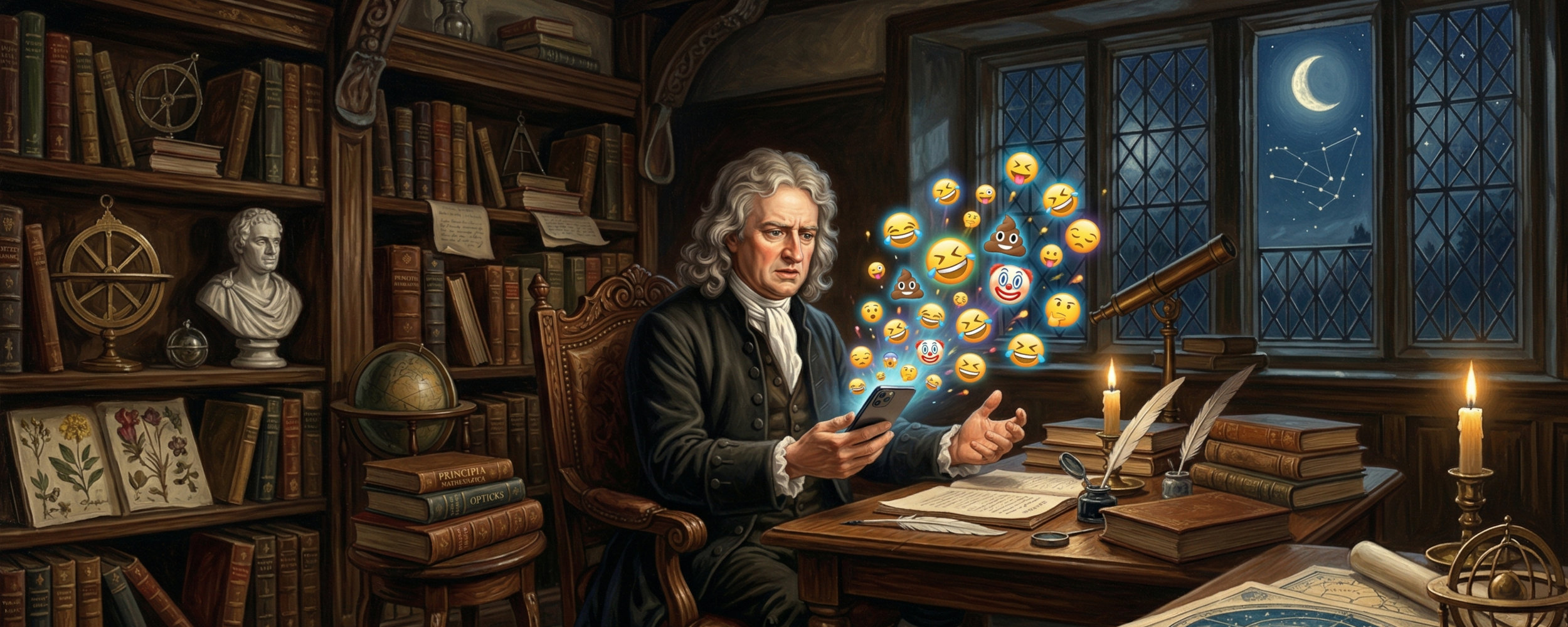
His worry was not that the public would disagree with him. It was that public discourse would devolve into pointless chaos with bad-faith and low-effort responses. Newton was describing Twitter three and a half centuries before it came into existence.
But even amongst the most accomplished and knowledgeable people in his time and in history, there were unproductive disputes he deemed worth avoiding. In Newton's preface to the Opticks, he explicitly writes: "To avoid being engaged in Disputes about these Matters, I have hitherto delayed the printing, and should still have delayed it, had not the Importunity of Friends prevailed upon me."3
Now contrast this to modern social media.
The Current Substrate
"I see I have made my self a slave to Philosophy" —Sir Isaac Newton4
Newton proposed an interpretation to his observations. He was met with unproductive backlash.
That's the general structure of debate on social media: people (to varying degrees of efficiency, accuracy, and rigor) share their observations and propose a solution. There exists an input and output relationship, as well as proposals to tweak the parameters that affect the output. Moreover, each debate implicitly asserts that its points are logical and therefore provable—as in: mathematically verifiable. As in: consistent. As in: uses deterministic logic with fixed definitions.
Therefore, the rightful environment of logical claims is in an environment designed for reasoning. Not amongst mobs, but in an environment that makes it cheaper and more efficient to coherently reason at scale, protect integrity, as well as make it easy to detect and pivot from contradictions.
In later editions of Opticks, Newton wrote that in experimental philosophy one should admit "no Objections against the Conclusions, but such as are taken from Experiments, or other certain Truths."5 He advocated for stating your assumptions explicitly, and only allowing objections that can themselves be mathematically verified. Anything else is noise and an obstacle.
Written and spoken discourse rarely make assumptions explicit. They often contain a mix of rigorously defined terms like numbers, partially defined terms, and undefined or internally inconsistent terms. Therefore, mapping a natural language claim to a coherent argument is a lossy and social endeavor. The overall flow from source to recipient is a logical mapping to an individual’s natural language interpretation to another individual’s natural language interpretation to a logical mapping. Then the best-guess logical representation is evaluated.
This multiplies exponentially in online discourse. Even in good-faith interactions, claims may need to be constantly re-explained for many years just as Newton begrudgingly did. This is the best case scenario.
On the other hand, incorrect claims are cheap to produce. They are asymmetrically costly to debunk, and debunking them doesn't prevent their recurrence. In online platforms, this too multiplies exponentially.
Building the Next Substrate
What would it take to change this? The history we began with suggests an answer. Writing, the printing press, mathematical notation, computers, and the internet didn’t solve problems directly. Rather, they provided the substrate in which problems could be solved more effectively. They changed the protocol of reasoning itself.
Our great pursuit, Axiom, which we are building at Coherence Labs, is this: a collaborative environment in which all statements are automatically and mathematically verified, assumptions are visible, logic is traceable, and counterproofs are enforced. We are not the arbiters of truth. Axiom enforces the rules of logic, not what you should believe—it's a formally verified communication protocol and knowledge graph. Everything is clearly an axiom or follows from axioms. Assumptions are explicit. Definitions are fixed. Context is always accessible. A mathematically false statement cannot be treated as mathematically consistent. And best of all, Axiom meets you where you are in your understanding with the help of AI. It's an environment designed to overcome the obstacles in discourse and social media—to be the next technological leap that makes reasoning and collaboration exponentially more efficient and powerful.
Newton's equations became the backbone of society because they were fixed, consistent, and verifiable, and so physicists centuries later extended the Principia without ever having met Newton. The most durable ideas of the next era will be the ones that don't require their author to be in the room. They will be transparent, traceable, and extendable by default.
Axiom is indeed different. But this difference is what creates unparalleled efficiency gains and a guarantee of logical validity. As with all technological endeavors, it takes longer to plan and takes some adaptation, but once adopted the advantage is so striking that it would simply be too costly to revert.
"To explain all nature is too difficult a task for any one man or even for any one age. 'Tis much better to do a little with certainty, & leave the rest for others that come after you, than to explain all things by conjecture without making sure of any thing." —Sir Isaac Newton6
Footnotes
-
Isaac Newton, Philosophiae Naturalis Principia Mathematica, 2nd ed. (Cambridge, 1713), General Scholium. English translation: The Mathematical Principles of Natural Philosophy, trans. Andrew Motte (London, 1729), vol. 2, 392. ↩
-
Isaac Newton, letter to Henry Oldenburg, 10 February 1671/2. In H. W. Turnbull (ed.), The Correspondence of Isaac Newton, vol. 1 (Cambridge: Cambridge University Press, 1959). ↩
-
Isaac Newton, Opticks (London, 1704), Advertisement I, dated 1 April 1704. Reprinted in Opticks, 4th ed. (London, 1730; repr. New York: Dover, 1952). ↩
-
Isaac Newton, letter to Henry Oldenburg, 18 November 1676. In H. W. Turnbull (ed.), The Correspondence of Isaac Newton, vol. 2 (Cambridge: Cambridge University Press, 1960), 182. ↩
-
Isaac Newton, Opticks, 2nd ed. (London, 1717/1718), Query 31. First published as Query 23 in Optice (London, 1706). Reprinted in Opticks, 4th ed. (London, 1730; repr. New York: Dover, 1952). ↩
-
Isaac Newton, unpublished draft preface for Opticks, c. 1700–1704. Cambridge University Library, MS Add. 3970, ff. 477r–480v. Transcribed in J. E. McGuire, "Newton's 'Principles of Philosophy': An Intended Preface for the 1704 Opticks and a Related Draft Fragment," British Journal for the History of Science 5, no. 2 (1970): 178–186. ↩